Spatial Foundry: A Multimodal Dataset for Spatial Intelligence

Spatial Foundry contains 2,400+ furnished residential 3D scenes with point clouds, editable meshes, aligned perspective and panoramic RGB, metric depth, 3D bounding boxes, and camera trajectories paired with video.

Explore the demosRequest a sample

Dataset Features

Shared scene coordinates establish correspondence across views, geometry and object instances. Per-frame camera poses register video observations to the 3D scene, while editable source assets support controlled variation in camera motion and scene state.

2,400+ 3D ScenesDiverse residential layouts and furnishing configurations
Perspective & Panoramic RGBCalibrated perspective and 360° observations of the same scenes
Camera Trajectories & VideoVideo sequences paired with frame-level camera poses
Depth & 3D Bounding BoxesMetric depth, object dimensions and persistent instance IDs
Point Clouds & 3D MeshesMetric point samples and editable scene geometry

Scene counts include alternative furnishing configurations of the same layout.

Research Applications

The demonstrations below illustrate the use of paired observations and 3D annotations for geometric learning, scene understanding, controllable generation and interactive world modeling.

V00

Dataset Overview

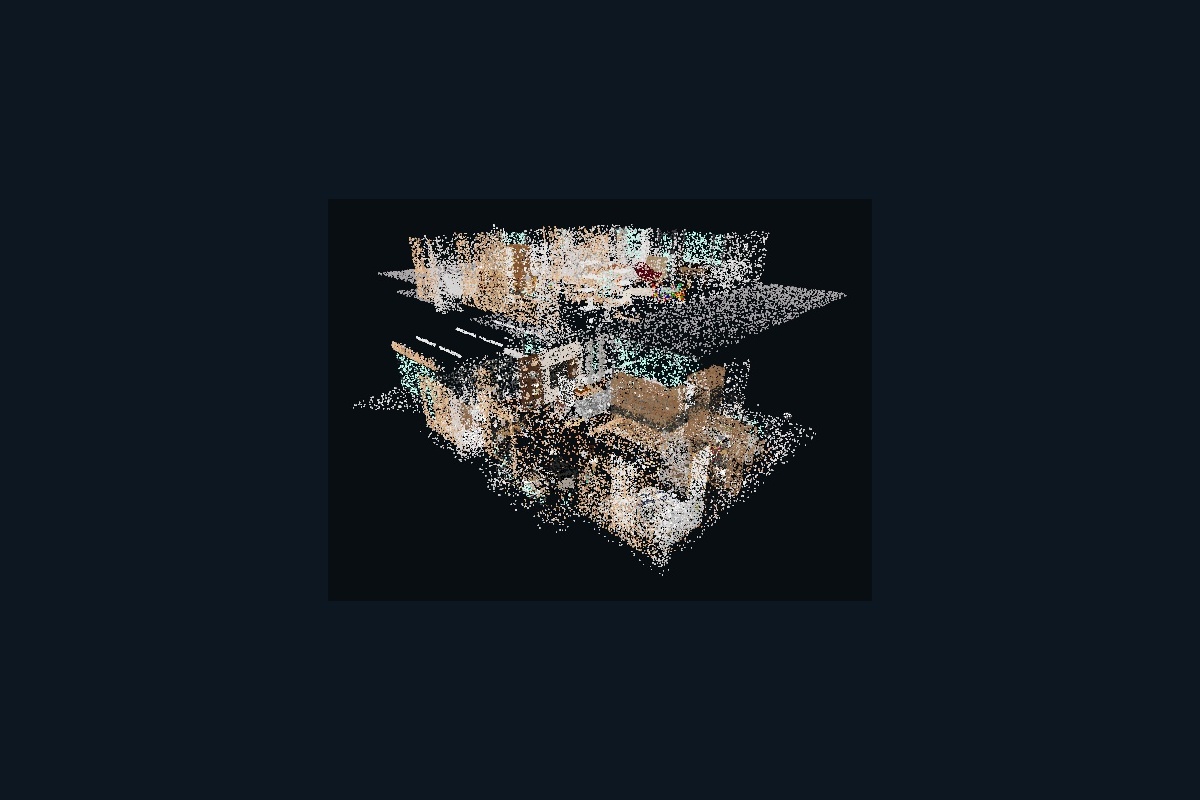
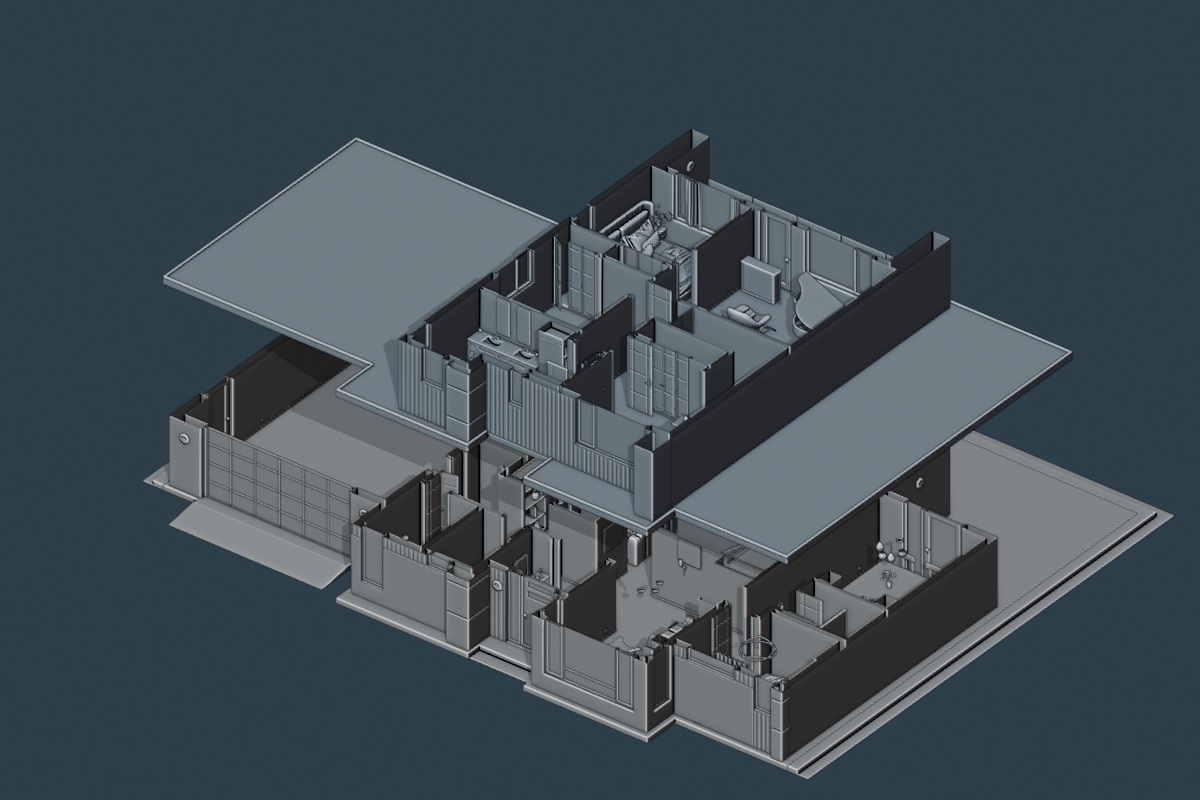
Furnished US-style residential environments are represented by floor plans, colored point clouds and editable 3D meshes. Perspective and panoramic observations are paired with metric depth, instance-level 3D annotations, and camera trajectories with corresponding video.
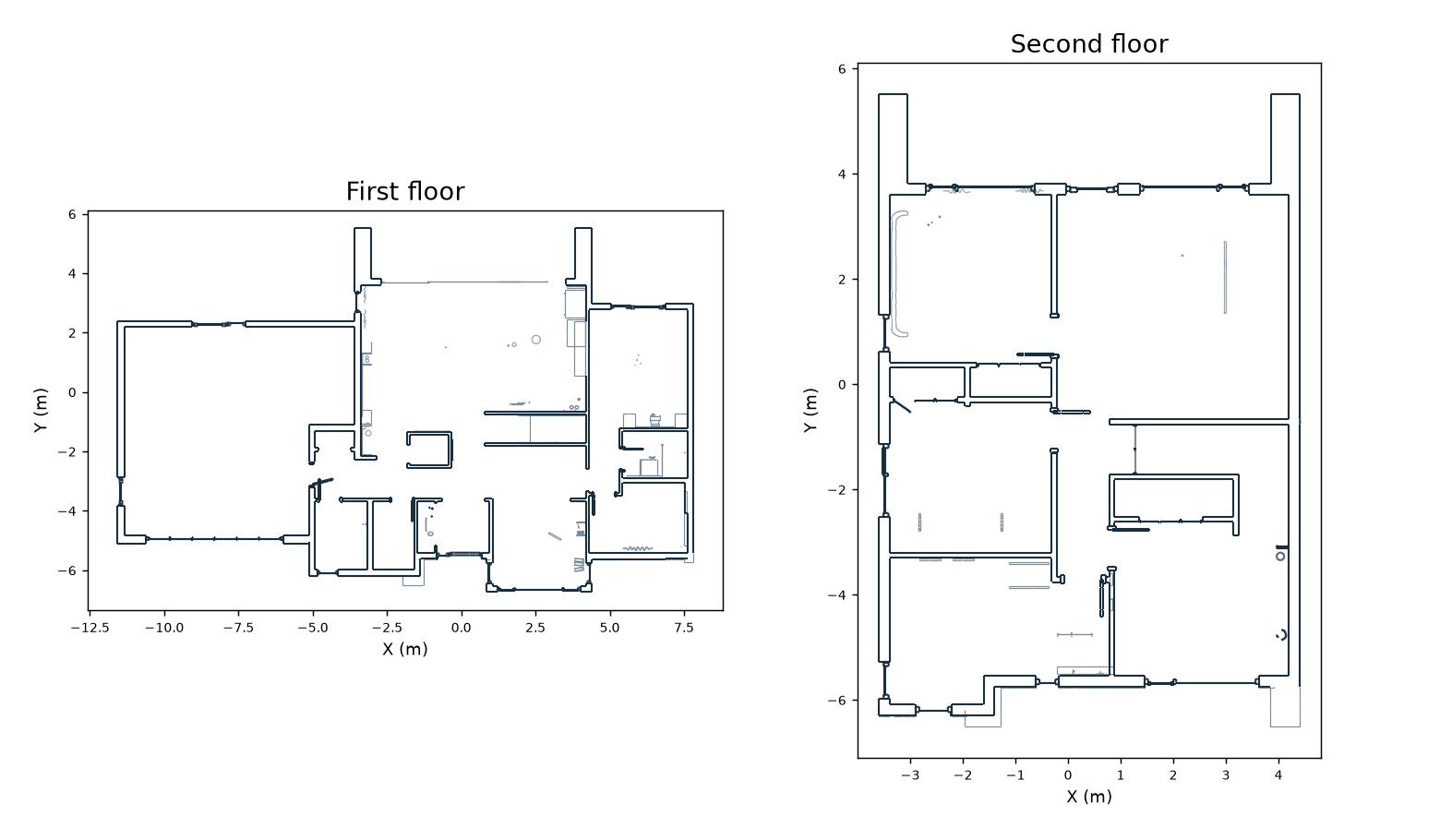
Three representations of the same two-floor home. Floors are separated for visibility in the 3D previews; source coordinates and dimensions remain metric.

Paired Observations & Annotations
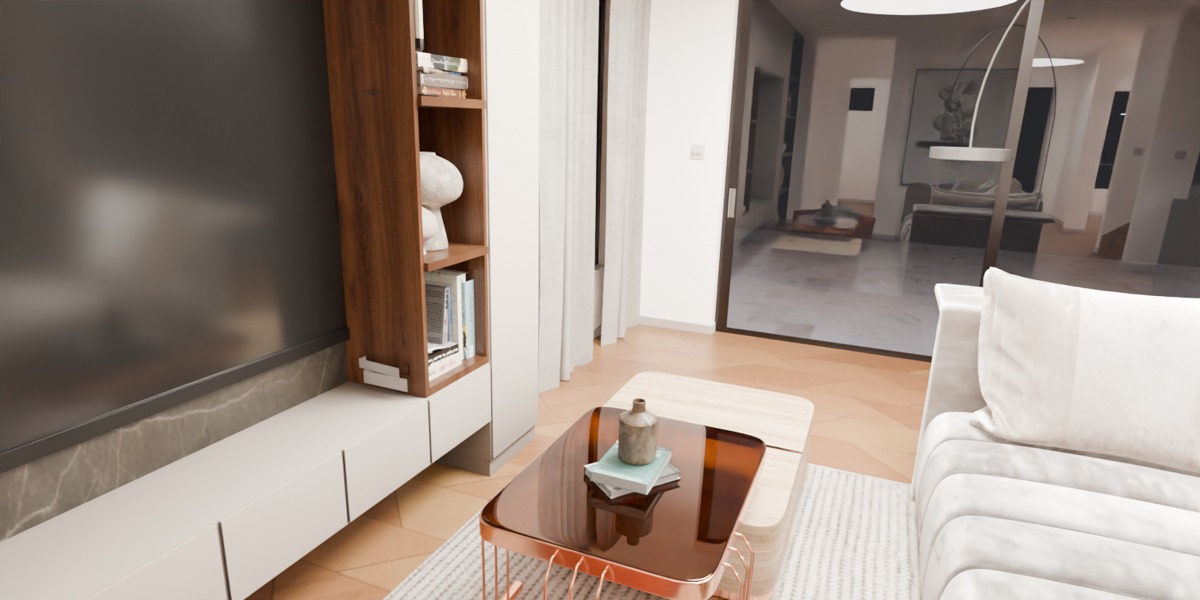
Floor plans, point clouds and editable meshes provide complementary representations of scene structure. Calibrated perspective and panoramic RGB are associated with metric depth, object IDs and 3D bounding boxes. Video frames are paired with camera trajectories and per-frame poses.

Training & evaluation

Scene-level splits support evaluation across environments. Metric geometry and calibrated observations provide references for scale, spatial layout, object localization and cross-view consistency.

Methods & provenance

The floor-plan, point-cloud and mesh previews depict the same two-floor Blender scene. Floor plans are derived from horizontal mesh sections. Point colors are estimated from UV textures and material Base Color; procedural shaders are approximated. The mesh preview shows actual surface geometry. Floors are separated for visibility in the default 3D previews; stored metric coordinates are unchanged.

V01

Scale & Diversity

The collection comprises 2,404 residential scene configurations spanning different layouts, room compositions and furnishing arrangements.

32 s · English Open video

Explore the Two-Floor Home

Drag to rotate · Scroll to zoom · Shift-drag to pan. You can also use the buttons, arrow keys and + / −.

The same home as V03 and V04 · 120,000-point preview · Surface original RGB from the supplied PLY

Residential scene configurations are paired with images, depth, camera calibration, object annotations and 3D geometry. Camera trajectories and corresponding videos preserve the relationship between local observations and global scene structure. Scene counts include furnishing variants of the same layout.

Training & evaluation

Partition by underlying layout or scene family to control leakage between furnishing variants. Compare performance across room configurations, object arrangements and camera viewpoints.

Methods & provenance

The 32-second demonstration combines a 36-scene gallery with first- and second-floor RGB views rendered from the featured Blender scene. The interactive preview uses 400,000 spatially sampled points from the supplied PLY, retaining its stored RGB and original coordinates. Floor separation and ceiling cutaways affect display only. The demonstration presents reference data rather than learned model outputs.

V02

RGB-D & Camera Geometry

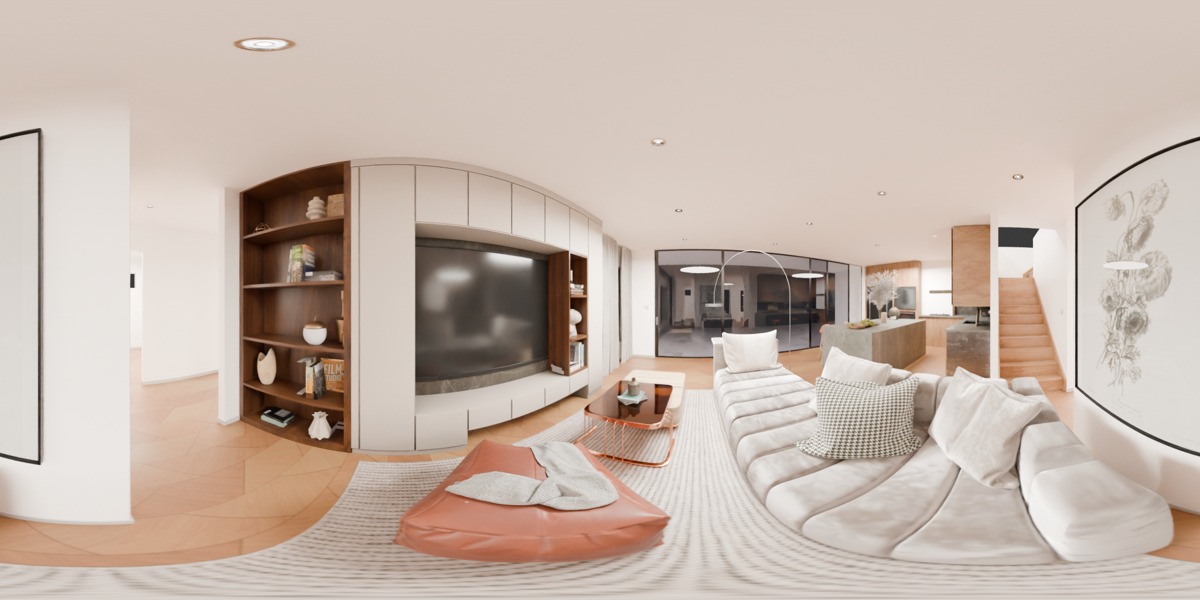
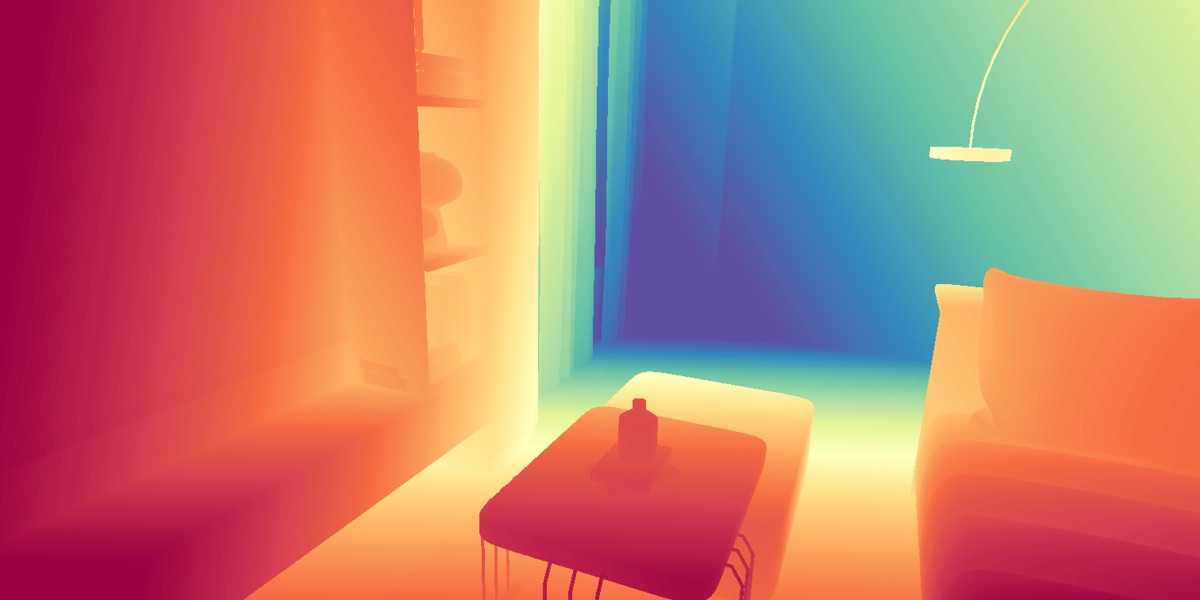
Perspective and panoramic RGB observations are associated with metric depth and camera calibration, providing aligned visual and geometric supervision for depth estimation, novel view synthesis and multiview reconstruction.

18 s · English Open video

Perspective RGB and depth are rendered directly from the source scene, with camera intrinsics and extrinsics retained. Equirectangular panoramas and explicit 3D geometry provide complementary representations of the same environment.

Training & evaluation

Paired RGB-D observations and calibrated views support depth-error measurement, metric-scale assessment and cross-view reprojection tests.

Methods & provenance

Perspective RGB and depth are rendered directly and unprojected using camera calibration. The final whole-house cloud is independently sampled from scene meshes and approximately colored by RGB projection; it is not reconstructed from a single panorama.

V03

3D Instance Annotations

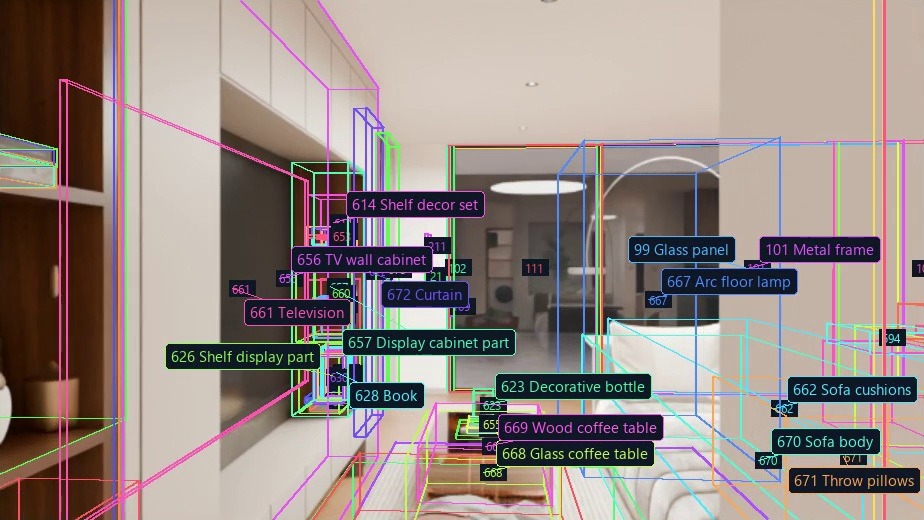
Persistent object IDs, metric dimensions and 3D bounding boxes associate image observations with scene instances. Corresponding RGB and point-cloud annotations support object localization and cross-view instance reasoning.

18 s · English Open video

Scene meshes, RGB observations and point clouds share object IDs and metric 3D bounds. Projected annotations establish correspondence between visible image regions and the underlying scene instances.

Training & evaluation

Evaluate localization, dimensions and instance correspondence against scene annotations. Semantic and orientation conventions are documented with the annotation fields.

Methods & provenance

The first- and second-floor inspection sequences share object IDs, metric dimensions and world-axis-aligned bounding boxes between RGB and point-cloud views. Displayed names use curated annotations; fine-grained semantic labels have not all been independently audited.

V04

Trajectory-Conditioned Video

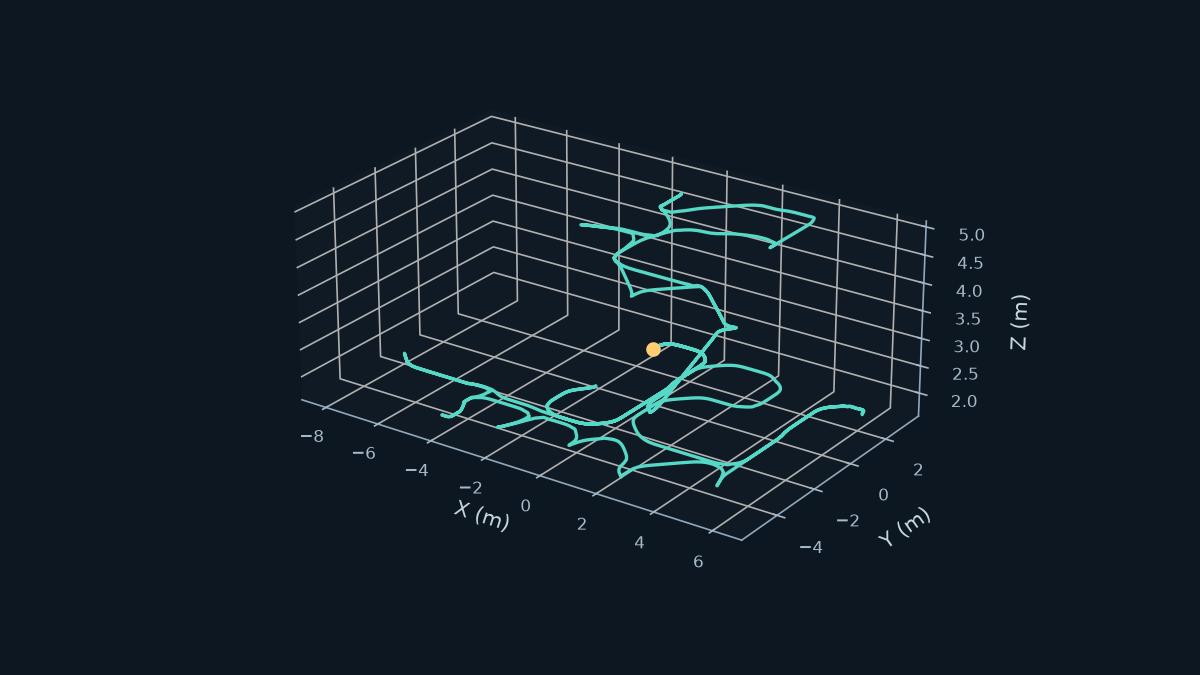
RGB video is paired with camera trajectories, intrinsics and timestamps. Continuous routes include room transitions, stair traversal, camera-height variation and return visits, providing reference sequences for trajectory-conditioned generation.

2 min 02 s · English Open video

Video frames are associated with camera poses, intrinsics and timestamps. Routes through furnished 3D scenes support controlled changes in viewing direction, height and speed while preserving the underlying environment.

Training & evaluation

Condition models on reference observations and target camera poses. Evaluate trajectory adherence, motion continuity and consistency across rooms, floors and revisited locations.

Methods & provenance

The reference sequence contains 2,923 frames at 24 fps and follows a continuous two-floor camera route. Traversal speed varies across room exploration, stair traversal and low-information transitions. The sequence is rendered in Blender; no learned video model is evaluated.

V05

Multi-Agent Collaboration

Synchronized observations from multiple participants are associated with a shared scene state. Object-state updates persist across independent viewpoints, supporting the study of consistency in online, multi-agent world models.

18 s · English Open video

Independent participant cameras are linked to shared object identities, transforms and edit events. Synchronized observations provide references for distinguishing viewpoint changes from changes in scene state.

Training & evaluation

Compare participant observations against the same state transitions. Assess event synchronization, cross-view agreement and persistence of changes over time.

Methods & provenance

H1 and ANYmal D represent participants in a local two-client TCP prototype. The video is pre-rendered from synchronized scene states. It does not evaluate robot dynamics or a publicly deployed generative world model.

V06

Real-Time Scene Editing

Object-level transformations and edit events are paired with observations along a camera path. Translation, insertion, removal and rotation produce persistent changes in scene geometry, visibility and rendered appearance.

24 s · English Open video

Editable object meshes, materials and transforms support explicit scene-state changes. Before-and-after observations are linked to the corresponding edits and camera poses.

Training & evaluation

Evaluate whether an edit matches the target transformation, preserves unrelated scene content and remains consistent in subsequent views.

Methods & provenance

Object translation, removal, insertion and rotation are applied to the Blender scene and rendered along a continuous camera path. The video illustrates data for real-time editing workflows; it is pre-rendered rather than a live editor capture.

Data Modalities

The dataset provides scene assets, calibrated observations and structured annotations. Camera trajectories, video frames and object identities establish correspondence across spatial and temporal observations.

CategoryDataResearch tasks
Scene assetsFurnished 3D meshes, floorplans and structural geometryLayout understanding, scene generation and controlled scene variation
Visual observationsPerspective and panoramic RGB, camera intrinsics and extrinsicsMultiview learning, novel view synthesis and geometric reprojection
Metric geometryDepth maps, point clouds, mesh geometry and object dimensionsDepth estimation, metric reconstruction and 3D localization
Instance annotationsObject IDs, semantic labels, 3D bounding boxes and cross-view instance correspondence3D detection, visual grounding and instance-level scene understanding
Trajectory–video pairsCamera trajectories, RGB video, frame-level poses and timestampsTrajectory-conditioned generation, navigation and temporal consistency evaluation
Scene-state changesObject transforms, edit events and observations of updated scenesAction-conditioned modeling, multi-agent interaction and edit consistency

Dataset Access

Evaluation samples are available to assess data formats, camera conventions and annotation structure. Contact the data team to discuss research requirements and licensing.

Data access covers RGB-D observations, multiview instance annotations, trajectory–video pairs, diverse scene configurations and observation sequences with recorded edits.

Contact the data team

data@ranolabs.ai